Introduction
Aerial photos answer buyer questions that ground photos cannot: how big is the lot, what condition is the roof in, what does the street and neighborhood actually look like? That is why a well-chosen drone shot earns its place in a listing.
But raw drone frames rarely ship as-is. Gray skies, thin haze, a tilted horizon, and finishing that does not match the ground set are the normal state of an unedited aerial — not the exception. This guide covers the drone photo editing workflow that fixes those four problems, what aerial editing typically costs, how to vet a drone photographer and editor, and when outsourcing beats editing in-house.
TL;DR: Aerial images fail for different reasons than ground photos — flat gray skies, haze, tilted horizons, and mismatched finishing across the set. Fix those four first, keep the result realistic, and outsource when volume exceeds your turnaround. Checklist and cost ranges inside.
If you are still deciding whether a listing needs aerials at all, start with our overview of drone photography for real estate marketing. This post picks up where that one ends: the shot is taken, now make it listing-ready.
What Aerial Editing Fixes That Ground Editing Doesn't
Aerials fail differently than ground shots, so they need their own editing logic. Four fixes cover nearly every listing-ready drone photo: sky replacement, haze and clarity work, horizon and vertical correction, and exposure matching to the ground set.
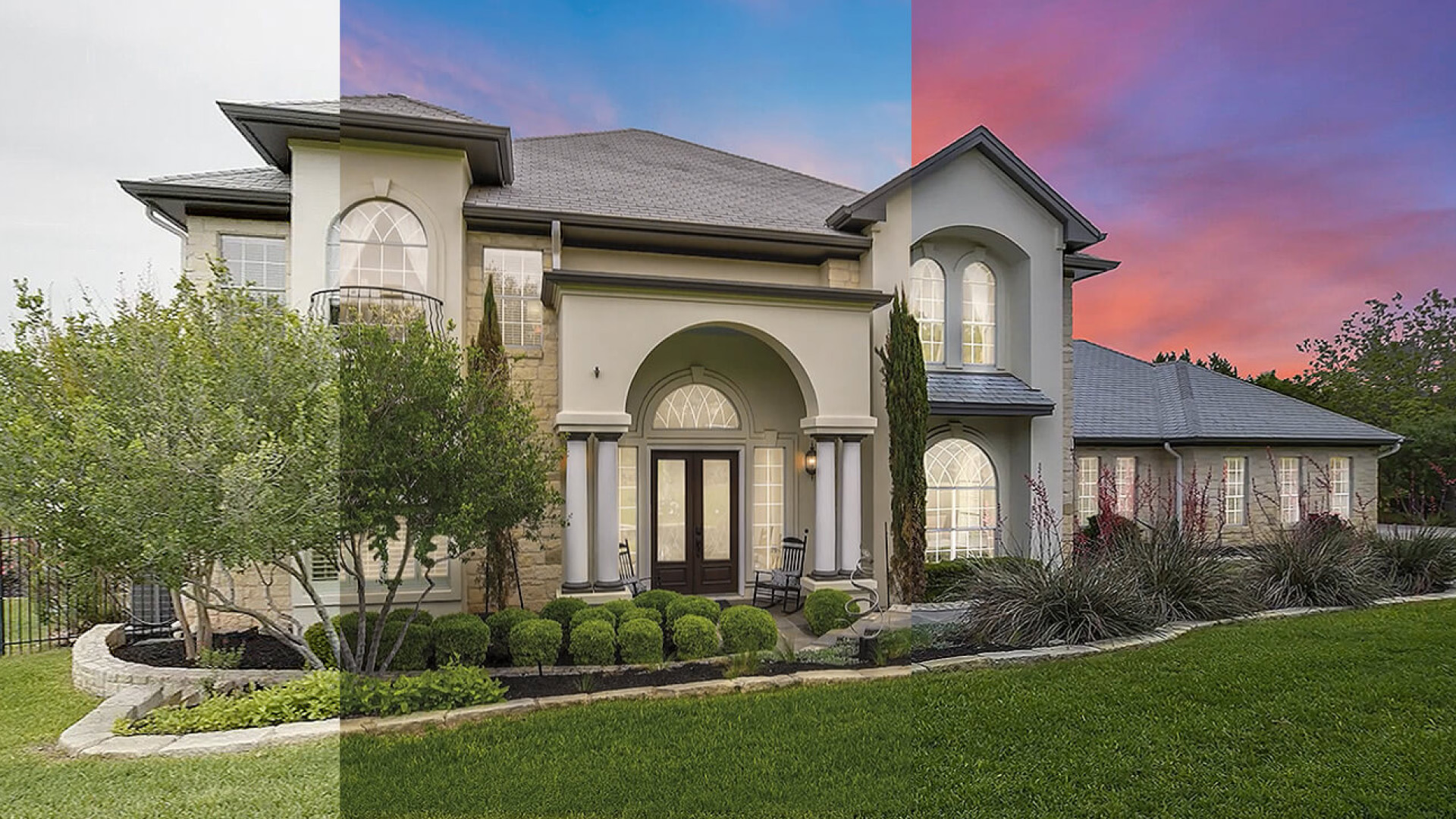
Sky replacement. Drone shoots happen on the schedule's day, not the weather's. A flat gray or blown-out sky gets replaced with a plausible blue sky with natural cloud structure. The boundary that matters: the replacement must look like weather that could have existed that day in that market — not a dramatic sunset composited over noon shadows.
Haze and clarity. Distance softens contrast. Light dehaze and local contrast work brings back definition in rooftops, tree lines, and neighboring streets without the crunchy, over-processed look that heavy-handed clarity sliders produce.
Horizon and vertical correction. Gimbal tilt and high-angle perspective leave horizons slightly off-level and verticals converging. Straightening the horizon and correcting verticals is quiet work — nobody notices it when done right, and everybody feels something is wrong when it is skipped.
Exposure matching to the ground set. The aerial must look like it belongs with the other 30 photos. Matching white balance, exposure, and color finishing across ground and aerial frames is what makes the full set feel like one listing instead of two different shoots stitched together.
The Aerial Editing Workflow, Step by Step
Order matters: geometry before color, color before sky, everything before the consistency pass. Working in this sequence prevents rework — there is no point perfecting a sky on a frame with a crooked horizon you will later crop away.
- Cull for the 1-2 keepers. Most listings need one establishing aerial, sometimes two. Pick the frames with the best angle and light; editing ten mediocre aerials is worse than perfecting one strong one.
- Fix geometry first. Straighten the horizon, correct converging verticals, crop to remove rotor-arm intrusions or distracting edge elements. Verify at full-frame view before moving on.
- Match exposure and white balance to the ground set. Open a finished ground photo from the same listing as reference. Match overall brightness, white balance, and contrast so the aerial sits naturally beside interiors. Verify by viewing the aerial and three ground shots side by side.
- Do the sky and haze work. Replace the sky only if needed; always dehaze with restraint. Verify edges at 100% zoom — halos around rooftops and trees are the tell of rushed sky work.
- Run the full-set consistency pass. Flip through the entire set, aerials included, checking that color temperature and finishing feel uniform. The aerial should be indistinguishable in grade from the rest.
- Manual QC before delivery. A second pair of eyes checks the list below. Nothing ships with a halo, a tilt, or a grade mismatch.
QC checks before delivery
- Horizon level across the full frame width
- No halo or fringe edges around rooftops and trees at 100% zoom
- Sky light direction consistent with shadows on the ground
- White balance matches the ground set from the same listing
- No over-sharpening artifacts in distant detail
This ordered QC is the core of any dependable professional photo editing workflow — aerials just surface its failures faster because the whole property is visible at once.
Sky Replacement Without the Fake Look
Realistic sky replacement comes down to three matches: light direction, color temperature, and clean edges. Get all three right and buyers see weather; miss one and they see Photoshop.
Wrong sun angle. The mistake: dropping in a bright afternoon sky over shadows that clearly fall the other way. The fix: check shadow direction in the ground shots from the same shoot and pick a sky with matching light. When in doubt, choose a softer, more neutral sky — it matches more lighting conditions.
Oversaturated blue. The mistake: an electric-blue sky that no local buyer recognizes from their own sky. The fix: keep saturation market-plausible. A believable light blue with natural cloud variation outsells a dramatic sky that triggers skepticism about what else was altered.
Halo and fringe edges. The mistake: bright outlines where the new sky meets rooftops, chimneys, and tree lines. The fix: inspect every sky boundary at 100% zoom and refine the mask until edges are clean. This single check separates professional work from obvious composites.
For the full technique background, see our sky replacement guidance.
What Does Aerial Editing Cost?
Start with the provider's own pricing — ours is broken down in the photo editing pricing breakdown. Aerial edits with sky work fall into the advanced-retouching tier (HDR blending, sky replacement, twilight conversion); check current rates on the pricing page before budgeting.
Three pricing structures cover most aerial-inclusive work:
- Per image. Best when volume fluctuates month to month. You pay the advanced-retouching rate only for the aerials that need it and standard rates for the rest of the set.
- Per listing. A flat fee for the full set including 1-2 aerials. Often cheaper for standard 20–40 image sets and simpler to budget per property.
- Subscription. Worth modeling once you pass roughly 5–10 listings per month — the per-image cost drops, but only if volume stays consistent enough to justify the commitment.
What moves the price: sky replacement complexity, object or clutter removal (vehicles, bins, neighboring construction), turnaround speed, and monthly volume. A single clean aerial with a straightforward sky swap sits at the low end; rush delivery on a large luxury set sits at the high end.
Hiring Checklist: Drone Photographer and Editor Vetting
Five checks before you hire. Ask for each one explicitly — professional operators expect these questions.
- Part 107 certification. Ask the photographer for their FAA Part 107 certificate. This is the commercial drone license in the United States; verify current requirements at faa.gov rather than taking any article's word for it, including ours.
- Remote ID compliance. Ask whether their drone broadcasts Remote ID identification data, required for most commercial operations — confirm the current rule text at faa.gov.
- Liability insurance. Ask for proof of coverage for drone operations — accidents over neighboring properties are the scenario insurance exists for.
- Real-estate portfolio, not landscapes. Aerial landscape photography and listing aerials are different skills. Look for prior listing work: correct altitude, property-centered composition, neighborhood context.
- Full-set delivery. Confirm they deliver (or coordinate with an editor who delivers) ground and aerial frames with consistent finishing — one grade across the whole set, not two looks stitched together.
When to Outsource vs. Edit In-House
Outsource when volume, turnaround, or consistency breaks — and trial one aerial set before committing. The decision rule is simple arithmetic: listings per month × images per listing × turnaround deadline. If your current editing setup cannot clear that math without late deliveries or visible quality variance across the set, the aerials are the first thing to outsource, because they are the most technically distinct frames in the set.
A free trial on one aerial set answers the only question that matters: does the finished frame match your ground set and your realism bar? Send your hardest frame, not your easiest — gray sky, haze, tilt included. If it comes back clean and on time, you have your answer.
For aerial-visible exteriors that also need furnishing help (patios, decks, empty pool areas), pair the edit with staging rather than treating them as separate jobs.
Frequently Asked Questions
How much does drone photography cost for a listing?
Start from the provider's pricing page — ours is summarized in the photo editing pricing breakdown. Pricing varies by market, property size, and scope, so treat any market figure as a starting point for quotes, not a price.
How fast is turnaround on aerial edits?
Only your provider's SLA counts here — ask for it in writing before you commit volume. Whatever the commitment, test it with a trial set under a real deadline before routing live listings through a new editor.
Do I need FAA certification to hire a drone photographer?
No. Certification applies to the operator, not the client. Your job is to verify the vendor's Part 107 certificate and insurance — items 1 and 3 on the checklist above — and to confirm current requirements at faa.gov.
Will edited aerials look fake to buyers?
They look fake when skies defy the shadows, when blue is oversaturated, or when edges halo — the three mistakes covered above. Realistic output with manual quality control before delivery is the safeguard: every frame checked at full zoom against the ground set before it ships.
Conclusion
- Aerials fail in four predictable ways: sky, haze, horizon, and set mismatch — fix those first.
- Work in order (geometry → color → sky → consistency → QC) and check edges at 100%.
- Budget from the provider's pricing page; use market ranges as estimates only.
- Vet operators on Part 107, Remote ID, insurance, listing portfolio, and full-set delivery.
Send one hard aerial set through a free trial and judge the result against your ground photos. If it matches, route your aerials out and keep your turnaround intact.